Gentle Back Pain Relief Exercises You Can Do at Home
The most common back pain I see in women over 60 is not the dramatic kind that puts you in bed. It is the quiet, nagging kind that steals small pleasures: the film you cannot sit through without shifting every few minutes, the long car journey you dread, the careful operation that tying your shoes has become.
Most of the women I work with on this kind of pain have been through the same pattern — a GP visit, a brief course of painkillers, a physio handout with three exercises that gets done sporadically and then drifts. After a while, the back is quietly filed under "how it is now."
It does not have to stay that way. With eight weeks of patient daily work, most chronic non-specific lower-back pain in this age group eases meaningfully. This article walks through the routine I use most often, plus the principles behind it, because principles travel further than a list of moves.
First: Not All Back Pain Is the Same
I have to say this up front. If your back pain is:
- Radiating down one leg with numbness or weakness
- Accompanied by bladder or bowel changes
- Worse at night and wakes you up
- The result of a recent fall or injury
- Not improving at all over 4–6 weeks
…please see a doctor or physiotherapist before starting any programme. The routine below is for the most common kind of chronic lower-back pain: muscular, postural, arising from years of weak core, tight hips, and generally not moving enough. The NHS has a clear overview of back-pain types worth reading.
Why Back Pain Is So Common After 60
Three overlapping reasons:
- Postural drift. Decades of sitting have shortened the hip flexors and weakened the glutes and deep core. The lower back ends up doing work it wasn't designed to do.
- Discs change. Spinal discs lose hydration and height with age, which subtly changes how the vertebrae align.
- Muscle mass declines. Without strength training, the muscles that support the spine weaken. the NHS overview of back pain has written extensively about this cascade.
The fix is almost always not rest. It's gentle, consistent movement that wakes up the muscles that should be doing the work.
A Realistic Starting Point
The first session with a new client in this situation is usually humbling. A simple plank on the knees often cannot be held for 15 seconds. Hip flexors are locked from years of sitting. Glutes fire so weakly that, asked to squeeze them, the person has to concentrate to find them. Daily pain sits around 5 out of 10.
The brief I give in that first session is always the same: we are going to do short sessions, every day. Nothing heroic. Nothing that hurts. And we are going to be boring about it. Boring, it turns out, is the part most people can do.
The Routine (15 minutes, daily)
Do this in order. Rest 15–20 seconds between exercises. Use a mat or a folded towel if the floor is uncomfortable.
1. Cat-Cow on Hands and Knees (1 minute)
On hands and knees (or standing with hands on thighs if floor work is hard), alternate arching and rounding your spine slowly. 8 slow rounds. This is a spinal warm-up — gold standard.
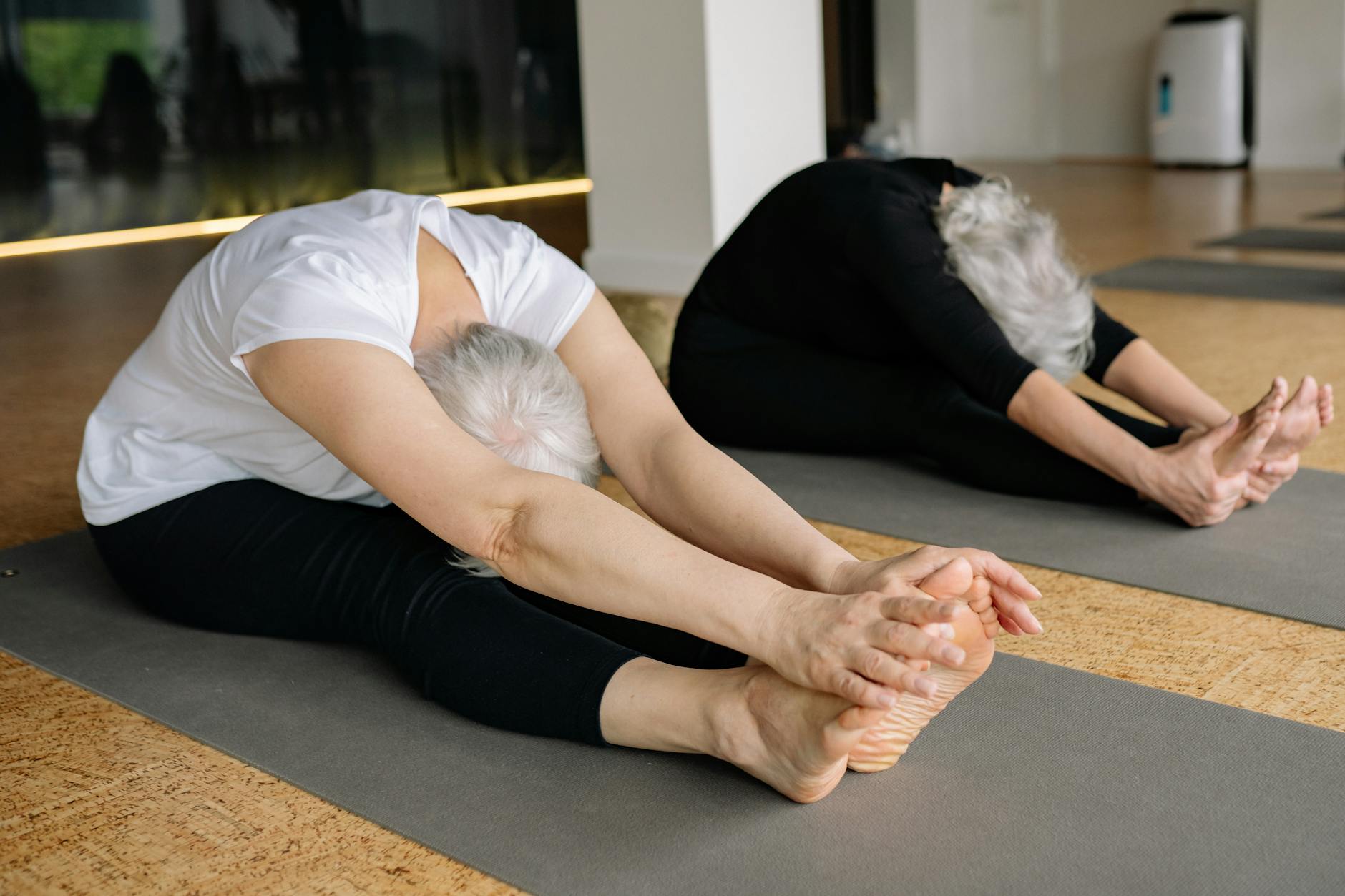
2. Child's Pose or Seated Forward Fold (30 seconds)
From hands and knees, sit your hips back toward your heels, arms extended forward. If kneeling is uncomfortable, sit on a chair and fold forward over your thighs. Hold and breathe.
3. Glute Bridge (2 minutes)
Lie on your back, knees bent, feet flat. Press through your heels and lift your hips until your body is a straight line from knees to shoulders. Squeeze your glutes hard. Lower with control. 10 repetitions, 2 sets.
This is the single most important exercise in the whole routine. Weak glutes = overworked lower back. Strong glutes = happy back.
4. Dead Bug (2 minutes)
Lie on your back, knees bent at 90 degrees in the air, arms reaching toward the ceiling. Slowly extend your right arm overhead and your left leg toward the floor, keeping your lower back pressed into the floor. Return and switch. 8 per side.
This teaches your deep core to stabilise your spine while limbs move, which is exactly what it needs to do in daily life.
5. Bird-Dog (2 minutes)
On hands and knees, slowly extend your right arm forward and your left leg back. Hold 3 seconds. Return. Switch. 8 per side. Move as if there's a glass of water on your lower back and you mustn't spill it.
6. Supine Figure-Four Stretch (1 minute)
Lie on your back, cross your right ankle over your left thigh. Reach through and pull your left thigh toward your chest. Hold 30 seconds. Switch.
This releases the piriformis and deep hip rotators, often the real source of what feels like back pain.
7. Hip Flexor Stretch (1 minute)
Kneel on your right knee, left foot forward in a lunge (use a cushion under the knee). Keep your torso upright and gently shift your weight forward until you feel a stretch in the front of your right hip. Hold 30 seconds. Switch.
Hip flexors are the quiet villains of lower-back pain after 60. Almost everyone's are too tight.
8. Wall Sit (2 minutes)
Back against a wall, slide down until your thighs are about 45 degrees (not a full squat unless that's easy). Hold 20–30 seconds. Stand up. Repeat 3 times.
This builds quad and glute strength without any load on the spine.
9. Standing Side Bend (1 minute)
Already in our morning stretching routine — reach right arm over to the left, hold, switch. It lengthens the sides of the torso, which is surprisingly relieving for the lower back.
10. Walking (the main event)
Yes, walking is part of the back-pain prescription. 20–30 minutes a day, most days. Guidance from NIAMS (NIH) consistently shows walking reduces chronic lower-back pain more than rest does. Start with what you can, build from there. Our 30-minute walking guide has a gentle plan.
What Makes the Difference
Three things, in my experience, separate people whose back pain quietly fades from those whose pain plateaus:
- They do it every day. Not "most days." Every day, even 5 minutes on bad days.
- They keep walking. Even when the back is cranky, a slow daily walk is better than nothing.
- They strengthen the glutes. This is the unlock. Once the glutes wake up, the lower back finally gets to rest.
What Not to Do
- Don't avoid bending forever. Learn to hinge from your hips with a neutral spine. It's the same skill you need for picking up grandchildren safely.
- Don't do loaded crunches or sit-ups with back pain — they load the spine the wrong way. Try the dead bug and bird-dog instead.
- Don't ice it for days. Short ice for acute flare-ups is fine; chronic pain responds better to heat and movement.
When to Add Strength Training
Once your pain is under a 3/10 reliably and the exercises above feel manageable, you're ready to add broader strength work. Our strength training after 60 guide has a sensible on-ramp.
My Opinionated Take
Most back pain in women over 60 is fixable. Not every woman. Not every back. But most. The reason so many women live with it isn't that their backs are beyond help. It's that no one showed them the boring, daily, gentle things that actually work.
Fifteen minutes. Every day. Eight weeks. Try it and see.
For video-led sessions and a structured programme, have a look at our exercise guide or register for free so you can follow along week by week. Most of the women I coach who stick with it are walking, hiking, and getting in and out of cars without thinking about it again within a couple of months. With patience and consistency, so can you.